
The Complete 2026 Site Selection Guide: What I'd Check Before Buying Land to Build
📋 Quick Navigation
Jump to Section
THE 5 CRITICAL CHECKS:
Bonus Checks: Additional Due Diligence
Free Site Selection Toolkit [COMING SOON]
Download Complete Checklist (PDF) [COMING SOON]
⚡ TL;DR - The Quick Version
Short on time? Here's what you need to know:
Making an offer on land? Run these 5 checks FIRST:
✅ Flood Zones → msc.fema.gov (Avoid Zones A, AE, AO, AH, V, VE)
✅ Cell Towers → antennasearch.com (Minimum ½ mile distance recommended)
✅ Power Lines → Call your utility for FREE EMF testing (Minimum 1/10 mile from high-voltage lines)
✅ Contamination → epa.gov/superfund (Check for Superfund sites, former industrial use)
✅ Deed Restrictions → Request CCRs from seller (Can add $50K+ in surprise costs)
📥 Download the complete printable checklist here
⏱️ Time investment: 10-15 hours of research could save you $50,000-$500,000+ in remediation costs.
Introduction: Why I'm Sharing This
After 14 years as a corporate attorney and becoming a Certified Passive House Builder following my family's toxic mold crisis, I've learned this truth the hard way:
Your building site matters (maybe even more than your floor plan).
You can change your countertops, upgrade your HVAC, and repaint every room. But you cannot move away from a cell tower, relocate high-voltage power lines, change your flood risk, or remediate contaminated soil without extraordinary expense—if it's even possible at all.
I've worked with too many families who discovered these issues six months after move-in:
The basement that floods every spring
The constant EMF exposure from transmission lines they didn't notice
The contaminated groundwater affecting their well
The $50,000 driveway requirement buried in deed restrictions they never read
These situations are 100% preventable.
This blog and the guides I’ve prepared provide the exact site selection checklist I use—combining my legal background, building science training, and hard-won personal experience.
Why Site Selection Deserves Your Full Attention
The Permanence Problem
Location decisions are fundamentally different from design decisions
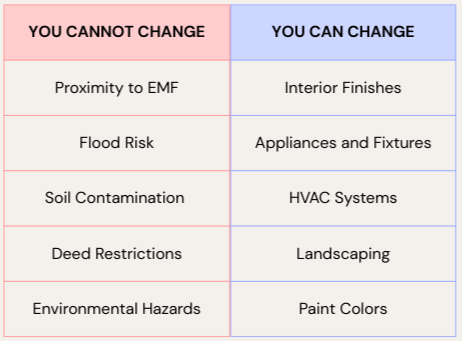
💰 The True Cost of Mistakes
Site-related issues often cost 10-50 times more to remediate than to identify upfront:
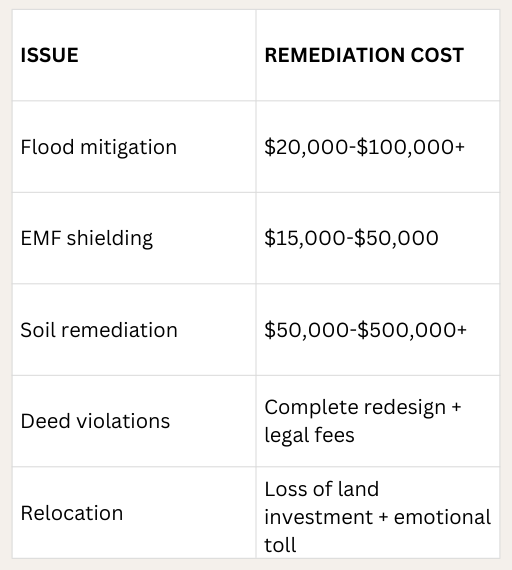
*Costs will vary greatly based on a variety of factors
🏥 The Health Implications
As a certified Healthy Home Consultant, I've seen how environmental factors affect families:
Chronic EMF exposure disrupting sleep and cellular function
Mold growth from unrecognized flood risk destroying health and property
Chemical sensitivities triggered by contaminated soil off-gassing
Stress-related illness from ongoing environmental concerns
Prevention isn't just cheaper—it's essential for long-term wellbeing.
CHECK #1: Flood Risk Assessment
⚠️ Why This Matters
"It's never flooded here" is not a risk assessment. Climate patterns are changing, hundred-year floods are occurring more frequently, and even "low risk" zones experience flooding.

Key Facts:
Flood damage causes billions in property losses annually
Creates perfect conditions for toxic mold growth
Affects property value and insurance costs permanently
🔧 What to Do
STEP 1: Check FEMA Flood Maps
🔗 URL: msc.fema.gov
Actions:
Enter the property address
Review the flood zone designation
Check historical flood data
Download the Flood Insurance Rate Map (FIRM)
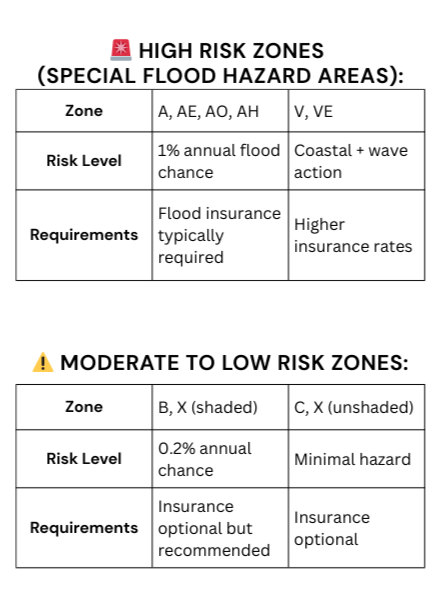
📊 Understanding Flood Zones
🚩 Red Flags
❌ Property in Zone A or V designation
❌ Historical flooding in area (ask neighbors!)
❌ Property at bottom of slope or in valley
❌ Poor drainage patterns visible
❌ Nearby creek, stream, or retention pond
❌ Recent flood zone map updates
💡 Beyond FEMA Maps
FEMA maps show official flood zones but don't capture everything:
✓ Drive by during/after heavy rain
✓ Check with local building department
✓ Review topographic maps
✓ Talk to neighbors about actual flooding history
“Pro Tip: Even if you’re not in a designated flood zone, consider the site’s elevation relative to surrounding properties and natural drainage patterns.”
CHECK #2: Cell Towers & Broadcast Antennas

⚠️ Why This Matters
Constant radiofrequency (RF) radiation exposure, particularly during sleep when your body attempts cellular repair and detoxification, is a primary concern in building biology.
Key Difference: Unlike your phone which you can turn off or distance yourself from, a nearby cell tower creates 24/7 exposure you cannot control.
📚 Professional Guidance
Paula Baker-Laporte, Certified Passive House Builder, recommends in A Healthy House:
MINIMUM ½ MILE (2,640 feet) from microwave cellular and broadcast towers
This distance recommendation is based on decades of building biology field experience and research into RF radiation exposure levels at various distances.
🔧 What to Do
STEP 1: Search for Nearby Towers
🔗 URL: antennasearch.com
Actions:
Enter the property address
Review ALL towers and antennas within 4-mile radius
Note the distance to each tower
Identify tower types (cellular, broadcast, microwave)
Check number of carriers on each tower
Important: Multiple carriers = multiple sets of antennas = potentially higher exposure
🚩 Red Flags
❌ Any tower within ½ mile (2,640 feet)
❌ Multiple towers in different directions
❌ Direct line of sight to tower from property
❌ Tower at similar or higher elevation than your property
❌ Plans for 5G small cell deployment in neighborhood
💡 Free Professional Testing
CRITICAL RESOURCE: Most public utility companies provide FREE on-site measurements for background electromagnetic field levels.
How to Request:
Contact your local electric utility company
Request a "background EMF survey" or "magnetic field measurement"
Schedule assessment before purchase closing
Request measurements at property boundaries and proposed building location
Additional Option: A Building Biology Environmental Consultant (BBEC) can conduct comprehensive RF measurements.
🔗 Find certified consultants at buildingbiologyinstitute.org
CHECK #3: High-Voltage Power Lines
⚠️ Why This Matters
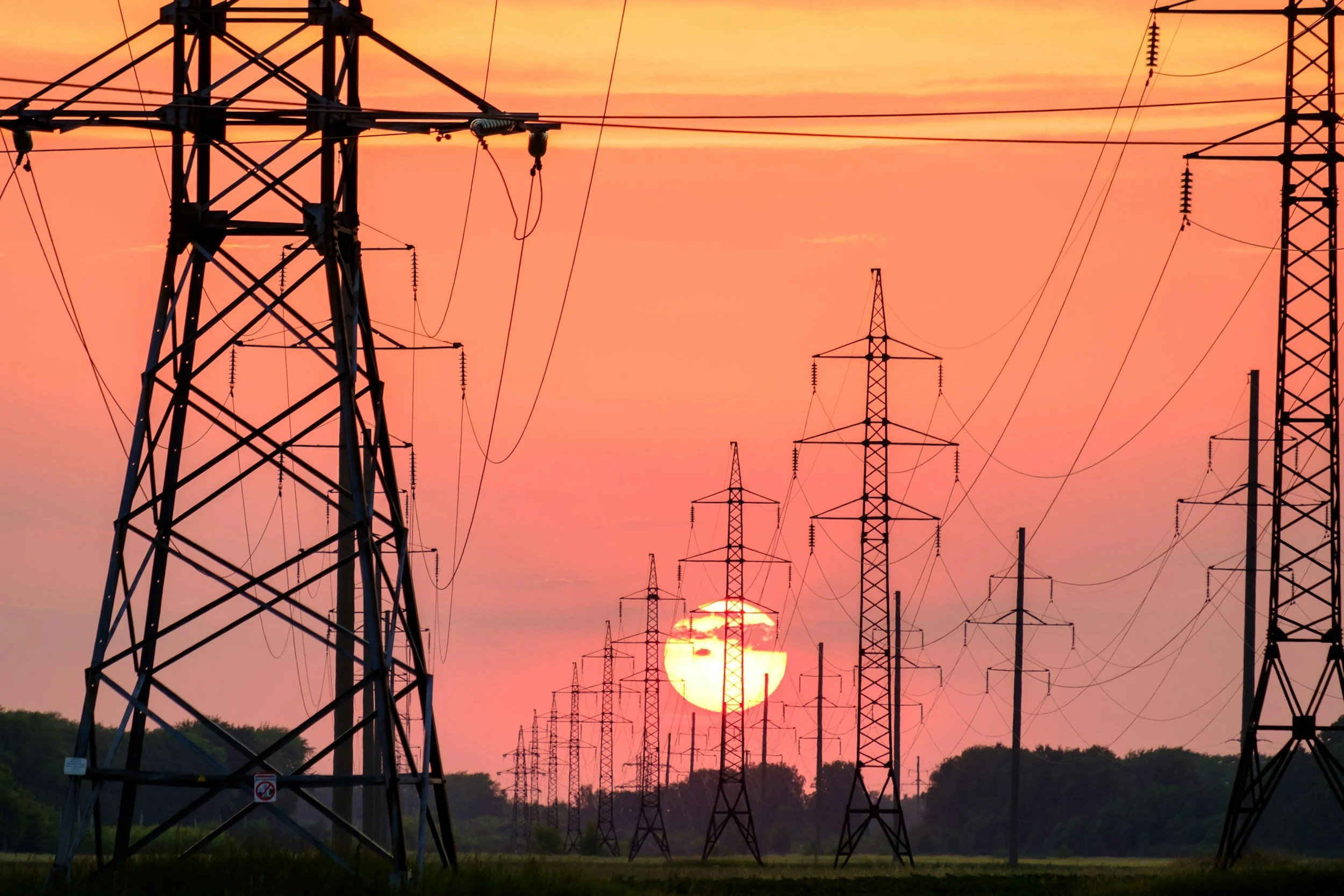
Transmission and distribution lines create electromagnetic fields (EMFs) that decrease with distance but never reach zero. Constant exposure, particularly in sleeping areas, is a concern for building biologists and health-conscious builders.
📚 Professional Guidance
Paula Baker-Laporte recommends in A Healthy House:
MINIMUM 1/10 MILE (528 feet) from high-voltage power lines
🔧 What to Do
STEP 1: Visual Inspection
Drive by the property and surrounding area looking for:
⚡ High-voltage transmission lines (tall metal towers)
⚡ Distribution lines (wooden poles with transformers)
⚡ Substations
STEP 2: Identify Voltage
How to Estimate:
Count the number of insulators or wires
Higher voltage = larger towers and more wires
Transmission lines: typically 115kV-500kV+
Distribution lines: typically 12kV-35kV
STEP 3: Calculate Safe Distances
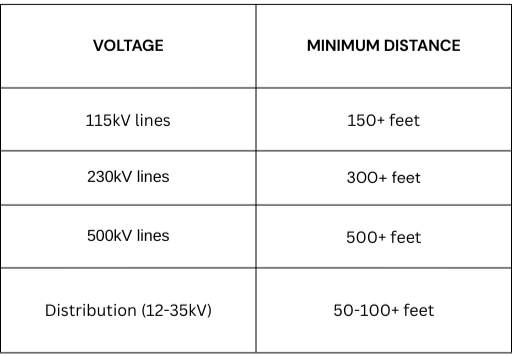
General Distance Guidelines:
💡 Free Professional Testing (CRITICAL)
Most public utility companies provide FREE on-site electromagnetic field measurements.
How to Request:
Contact your local electric utility company
Request a "background EMF survey"
Schedule before closing
Get measurements at property boundaries and proposed building site
This service is FREE and provides actual EMF readings specific to your site.
🚩 Red Flags
❌ Transmission lines crossing property
❌ Lines within 500 feet of proposed home site
❌ Direct line of sight to power lines from bedrooms
❌ Substations within ¼ mile
❌ Buzzing or humming audible from power lines
💡 If You Already Own the Lot
Design solutions if power lines are present:
Position home as far from lines as possible
Locate bedrooms on side away from lines
Use EMF shielding materials in walls facing lines if conditions/climate allow
Plant dense vegetation as partial barrier
Get whole-home EMF measurement and mitigation plan by building biologist
CHECK #4: Superfund & Contaminated Sites
⚠️ Why This Matters
Contaminated soil doesn't just stay in the ground—it affects your air quality, groundwater, and health.
Common sources:
Previous industrial use
Underground storage tanks
Dry cleaning operations
Landfills
These can leave lasting contamination that makes a site unsuitable or extremely expensive to develop safely.

🔧 What to Do
STEP 1: Search EPA Superfund Sites
🔗 URL: epa.gov/superfund/search-superfund-sites
Actions:
Enter property address or zip code
Review all listed sites within 3-mile radius
Check contamination status (active, remediated, monitoring)
Review list of contaminants present
Check groundwater flow direction
📊 Understanding Site Status
National Priorities List (NPL) Sites:
Most serious contamination
Federal cleanup oversight
Multi-year remediation timelines
Potential health risks to nearby residents
Site Status Categories:
Assessment: Being evaluated
Cleanup: Active remediation
Remediated: Cleanup completed
Monitoring: Post-cleanup observation
Important: "Remediated" doesn't always mean "safe for residential use." Review the remediation plan and any deed restrictions.
🔍 Additional Contamination Sources to Check
Former Industrial Sites:
✓ Factories, foundries, metal plating
✓ Chemical manufacturing or storage
✓ Railroad yards
✓ Auto salvage or repair
Dry Cleaners:
✓ Perchloroethylene (PCE) contamination
✓ Migrates through soil and groundwater
✓ Can affect properties blocks away
Gas Stations:
✓ Underground storage tank (UST) leaks
✓ Petroleum hydrocarbon contamination
✓ Check state UST database
Landfills and Dumps:
✓ Former municipal landfills
✓ Construction debris dumps
✓ Agricultural chemical disposal
Agricultural Use:
✓ Heavy pesticide application history
✓ Arsenic-based pesticides (older orchards)
✓ Lead arsenate in former agricultural areas
🔍 How to Research
County Environmental Health Department: Historical land use records
State Environmental Agency: Contaminated sites database
Title Search: Environmental liens or restrictions
Phase I Environmental Site Assessment: Professional environmental report (recommended)
Neighbors and Local Historians: What was here 50+ years ago?
🚩 Red Flags
❌ Property within 1 mile of Superfund site
❌ Former commercial/industrial use on or near property
❌ Discolored soil, stressed vegetation, or unusual odors
❌ Abandoned underground tanks or equipment
❌ Environmental liens in title search
❌ Seller reluctance to allow soil testing
💡 Due Diligence Recommendations
For any property with potential contamination concerns:
Phase I Environmental Site Assessment (ESA):
Professional review of site history
Database searches
Visual inspection
Cost: $2,000-$5,000
Worth every penny
Phase II ESA (if Phase I raises concerns):
Soil and groundwater sampling
Laboratory analysis
Contaminant mapping
Cost: $5,000-$15,000+
Make purchase contingent on satisfactory environmental assessment.
CHECK #5: Deed Restrictions & Covenants
⚠️ Why This Matters (Attorney Perspective)
As an attorney, I've seen deed restrictions destroy project budgets and timelines more than any other single factor.
Real examples:
"Affordable" lot with mandatory brick exterior when you planned fiber cement? Add $30,000+
Required 600-foot paved driveway to comply with subdivision rules? Add $60,000+
Setback requirements forcing you into smaller footprint? Complete redesign
These requirements are legally binding. You cannot build your way around them without variance approval (expensive and uncertain) or complete compliance (expensive and certain).

🔧 What to Do
STEP 1: Request Complete Documentation
Before making an offer, obtain:
Covenants, Conditions & Restrictions (CCRs)
Homeowners Association (HOA) Rules and Regulations
Architectural Review Committee Guidelines
Subdivision Plat and Restrictions
Any recorded easements or restrictions
Where to Get These:
Seller should provide
Title company will identify in title search
County recorder's office (recorded documents)
HOA management company
Municipal planning department
📋 Critical Items to Review
EXTERIOR MATERIALS REQUIREMENTS
Watch for:
Siding types (brick, stone, fiber cement, metal)
Roofing materials (composition, metal, tile)
Color palettes or prohibited colors
Minimum percentages of premium materials
Example: "All homes must be minimum 70% brick or stone on street-facing elevations" can add $25,000-$50,000 to your budget.
SETBACK REQUIREMENTS
Front, rear, and side yard minimums
Distance from property lines
Impact on buildable area
May limit home size or layout
DRIVEWAY AND ACCESS
Paved vs. gravel requirements
Minimum or maximum length
Shared access or private drive
Entrance location restrictions
Example: Rural lots with 500-1,000 foot driveway requirements can cost $50,000-$100,000+ for paving.
BUILDING SIZE AND HEIGHT
Minimum square footage requirements
Maximum height restrictions
Maximum lot coverage
Garage requirements
ARCHITECTURAL STYLE
Approved/prohibited styles
Roof pitch requirements
Window type and placement
Exterior lighting restrictions
LANDSCAPING REQUIREMENTS
Minimum plantings
Irrigation systems
Fence types and heights
Tree preservation
OTHER COMMON RESTRICTIONS
Outbuilding limitations (sheds, workshops)
RV/boat storage
Solar panel placement
Exterior equipment visibility (HVAC, satellite dishes)
Construction timelines
Builder approval requirements
📝 The Approval Process
Many subdivisions require Architectural Review Committee (ARC) approval before construction.
Typical Requirements:
Submit complete plans for review
Pay review fees ($500-$2,500)
Wait 30-90 days for approval
Possible multiple revision rounds
All changes must be re-approved
Budget Impact:
Delays can cost thousands in carrying costs
Required changes may require architect fees
Some changes affect structural design (expensive)
🚩 Red Flags
❌ Seller unwilling to provide CCRs before offer
❌ Vague or outdated architectural guidelines
❌ Active HOA with history of lawsuits
❌ Restrictions that conflict with your building plans
❌ "Builder must be approved by developer" clauses
❌ Mandatory use of specific contractors
❌ Unusual or burdensome restrictions
💡 Legal Review Recommendation
Have an attorney review all restrictions BEFORE making an offer, especially if:
Building in a new development
Architectural review is required
Restrictions seem unusual or overly restrictive
You plan anything non-standard (modern design in traditional neighborhood, metal roof, etc.)
Cost: $500-$1,500 for legal review
Value: Potentially saving $50,000+ in surprise cost
💡 What If You Already Purchased?
If you own the lot but just discovered restrictive covenants:
Work within restrictions creatively (architect can help)
Request variance from HOA/ARC (prepare detailed justification)
Negotiate with neighbors if private restrictions
Check for unenforceability (restrictions may have expired—attorney can advise)
Consider resale if restrictions make your goals impossible
BONUS CHECKS: Additional Due Diligence

🔍 Soil Quality and Suitability
Why: Soil conditions affect foundation options, drainage, and construction costs.
What to Check:
Percolation test (if septic system needed)
Soil bearing capacity (for foundation design)
Expansive soil testing (clay soils that swell/shrink)
Rock depth (affects excavation costs)
Cost: $500-$2,000 for geotechnical assessment
Red Flags: High water table, expansive clays, bedrock near surface, poor drainage
💧 Water Table Depth
Why: Affects basement feasibility, foundation waterproofing needs, and drainage design.
What to Check:
Water table depth during wet season
Seasonal fluctuations
Impact on basement construction
Drainage requirements
How: Geotechnical engineer can assess during soil testing
Red Flags: Water table within 8 feet of proposed basement floor, significant seasonal fluctuation

🌬️ Prevailing Winds and Air Quality
Why: What you're downwind from matters for air quality.
What to Check:
Prevailing wind direction (typically west to east in US)
Upwind sources: industrial facilities, feedlots, landfills, highways
Seasonal variations
Local air quality data
Resources:
🔗 airnow.gov for air quality data
Wind rose data from weather stations
Topographic maps showing terrain features
Red Flags: Downwind from industrial operations, major highways, agricultural operations with odor issues
🏗️ Future Development Plans
Why: Today's peaceful lot could be tomorrow's commercial corridor.
What to Check:
Municipal comprehensive plan
Zoning of adjacent properties
Planned roads or infrastructure
Upcoming rezonings or variances
Development applications in area
Where to Look:
City/county planning department
Zoning maps
Capital improvement plans
Local planning commission agendas
Red Flags: Adjacent commercial zoning, planned road expansions, lots zoned for high-density development

🌾 Pesticide and Agricultural History
Why: Former agricultural use may leave lasting contamination (lead arsenate, DDT, etc.)
What to Check:
Historical aerial photos
County agricultural records
Former orchard locations (lead arsenate)
Cotton fields (arsenic, DDT)
Resources:
County agricultural extension office
USDA historical records
Testing: Soil testing for heavy metals and pesticide residues if agricultural history suspected

☢️ Radon Risk
Why: Radon is the second leading cause of lung cancer (after smoking).
What to Check:
EPA radon zone maps
County radon testing data
Test results from neighboring homes
Resources:
State radon offices
Action: Plan for radon mitigation system ($1,500-$2,500) if building in Zone 1 (highest risk)

💧 Well Water Quality (If Applicable)
Why: Private wells aren't regulated like municipal water; testing is your responsibility.
What to Do:
Research Enevive water testing for FREE comprehensive analysis and customizable plan
Test neighboring wells (if permitted)
Plan for comprehensive water testing post-well installation
Budget for treatment systems based on likely contaminants
Common Issues:
Hard water (minerals)
Bacterial contamination
Nitrates (agricultural runoff)
Arsenic, uranium (natural geological)
PFAS (industrial contamination)
Your Action Plan: Step-by-Step Timeline

BEFORE MAKING AN OFFER
📅 WEEK 1: Desktop Research (4-6 hours)
Run all 5 primary searches
Request CCRs and deed restrictions from seller
Review FEMA flood maps
Check AntennaSearch for cell towers
Search EPA Superfund database
Identify high-voltage power lines (drive-by + maps)
Create preliminary concerns list
📅 WEEK 2: Site Visits and Conversations (3-5 hours)
Visit property at different times:
Morning rush hour (traffic noise)
Midday (light, shadows, noise)
Evening (activity patterns, lighting)
After rainfall (drainage, flooding)
Talk to neighbors about:
Flooding history
Development plans
Health concerns (tactfully)
HOA experiences
Visit local planning department:
Future development in area
Zoning of adjacent properties
Any variances or special permits nearby
📅 WEEK 3: Professional Assessments (If concerns identified)
Schedule free utility EMF testing (if power lines present)
Request Phase I Environmental Site Assessment (if contamination concerns)
Attorney review of deed restrictions (if complex or restrictive)
Geotechnical assessment (if soil concerns)
📅 WEEK 4: Make Informed Decision
Compile all findings
Calculate remediation costs if issues identified
Determine if site meets your requirements
Make offer with appropriate contingencies OR walk away
MAKING YOUR OFFER: Protecting Yourself
Include These Contingencies:
1. "Buyer's approval of all covenants, restrictions, and easements"
Gives you out if restrictions are unacceptable
Standard 5-10 day review period
2. "Satisfactory environmental site assessment"
If Phase I raises concerns
Seller may negotiate remediation or price reduction
3. "Buyer's approval of property condition and suitability for intended use"
Broader protection
Allows exit if any deal-breakers discovered
4. "Satisfactory soil and geotechnical assessment"
If building requires specific foundation type
Protects against unforeseen soil issues
Important: Work with a real estate attorney familiar with land transactions to craft appropriate contingencies for your situation.
AFTER PURCHASE: If Issues Are Identified
You already own the lot but discovered concerns?
Don't panic. Knowledge = better decisions.
FOR EMF CONCERNS:
Get professional EMF measurements
Position home away from EMF sources
Locate bedrooms on side with lowest EMF
Use EMF shielding materials in critical areas
Plan for wired (not wireless) home systems
FOR FLOOD RISK:
Consult with drainage engineer
Elevate home above base flood elevation
Design comprehensive drainage system
Avoid basements or use flood-resistant construction
Purchase appropriate flood insurance
FOR CONTAMINATION:
Phase II Environmental Site Assessment
Determine contamination extent and type
Consult environmental attorney about liability
May negotiate price reduction or cleanup
FOR RESTRICTIVE COVENANTS:
Have attorney review enforceability
Request variance from HOA/ARC
Consult architect for compliant design alternatives
Work within restrictions creatively
The Big Picture: Making Peace with Imperfection
After reviewing these five checks plus bonus items, you might feel overwhelmed. That's normal.
No site is perfect.
The goal isn't to find a lot with zero concerns—that lot doesn't exist.
The goal is to:
✅ Know what you're dealing with before you buy
✅ Understand the costs of mitigation or remediation
✅ Make informed trade-offs based on your priorities
✅ Avoid deal-breakers that would make the site unsuitable
Prioritizing Based on Your Values
HEALTH-FOCUSED FAMILIES:
EMF exposure is oftentimes non-negotiable
Flood risk = mold risk (critical to avoid)
Contamination is highest concern
Deed restrictions are flexible
BUDGET-CONSCIOUS BUILDERS:
Deed restrictions could blow budget (critical to review)
Soil conditions affect foundation costs (test early)
Flood risk = expensive insurance + mitigation
EMF can be partially mitigated with design
LONG-TERM INVESTMENT:
Future development affects property value
Environmental concerns affect resale
Flood zone affects insurance and marketability
All concerns should be weighted

Questions to Ask Yourself
Which concerns are absolute deal-breakers?
Which can be mitigated with design or technology?
What's your budget for addressing identified issues?
How long do you plan to live here?
Are you building for your family or for resale value?
What trade-offs are you willing to make?
Your Site Selection Toolkit: Quick Reference
🔗 Free Online Resources
Flood Risk:
🔗 msc.fema.gov - FEMA Flood Map Service Center
Cell Towers:
🔗 antennasearch.com - Cell Tower & Antenna Database
Power Lines:
🔗 emfanalysis.com/calculator - EMF Safe Distance Calculator
📞 Your local utility company - FREE on-site EMF measurements
Environmental Contamination:
🔗 epa.gov/superfund/search-superfund-sites - EPA Superfund Site Search
🔗 Your state environmental agency - State contaminated sites database
Deed Restrictions:
📄 Request from seller or title company
🏛️ County recorder's office - Recorded restrictions
Air Quality:
🔗 airnow.gov - Current air quality data
Radon:
🔗 epa.gov/radon - Radon zone maps and testing info
Historical Site Information:
🔗 historicaerials.com - Historical aerial photos
👥 Professional Resources
Building Biology Consultants:
🔗 buildingbiologyinstitute.org - Find certified BBEC
Environmental Assessments:
Local environmental engineering firms
Phase I ESA: $2,000-$5,000
Phase II ESA: $5,000-$15,000+
Geotechnical Assessment:
Local geotechnical engineers
Soil testing: $500-$2,000
Legal Review:
Real estate attorney
Deed restriction review: $500-$1,500
📚 Recommended Reading
"A Healthy House" by Paula Baker-Laporte, Erica Elliott, and John Banta
Comprehensive guide to healthy home building including site selection, materials, and building science principles. This is the foundational text I reference for EMF distance recommendations and healthy building practices.
📥 Download Your Free Site Selection Checklist
I've created a printable PDF checklist with all 5 critical checks, bonus items, and resource links for easy reference during property visits.
What's Included:
✅ Complete 5-check process with checkboxes
✅ All tool URLs and resources
✅ Red flags to watch for
✅ Space for notes and measurements
✅ Professional assessment recommendations
✅ Contingency language suggestions
No spam. Just practical resources for building your healthy home.
Final Thoughts: Due Diligence Is an Investment, Not an Expense
As both an attorney and a Certified Passive House Builder who learned these lessons through personal crisis, I can tell you:
Every hour you spend on site due diligence could save you thousands of dollars and years of health problems.
The cost of this research:
Your time: 10-15 hours
Professional assessments (if needed): $3,000-$10,000
The cost of discovering problems after construction:
Remediation: $20,000-$500,000+
Health impacts: Priceless
Emotional toll: Immeasurable
When my family experienced toxic mold exposure in our home, I learned that your home's foundation isn't just concrete—it's the land it sits on. Every decision flows from that initial choice of where to build.
You deserve to make that choice with complete information.
Ready to Build Your Healthy Home?
For Homeowners Planning to Build:
Services Available:
🏡 Pre-purchase site assessments
🔬 Healthy materials consultation
🏗️ Healthy home design guidance
Schedule a Consultation → New Client Intake Form
For Real Estate Professionals:
If you're a realtor serving health-conscious clients, the CHH Realtor Certification provides comprehensive training on site selection, healthy home features, and how to guide wellness-focused buyers with confidence and appropriate boundaries.
You'll learn:
How to identify environmental concerns during site visits
Proper disclaimers and liability protection
When and how to refer to specialists
Marketing your expertise with legitimate credentials
Learn More About CHH Realtor Certification
Share This Resource
Know someone buying land or planning to build? Share this guide with them. Prevention is always easier than remediation.
About the Author

Cristina, JD, CPHB
Founder, Conscious Healthy Home, LLC
Cristina brings a unique perspective combining 14 years as a corporate attorney advising Fortune 500 companies with specialized training as a Certified Passive House Builder and Building Biology Advocate. After her family's toxic mold exposure transformed her mission in life, she founded Conscious Healthy Home to help others avoid environmental health disasters through proper site selection, healthy building practices, and evidence-based guidance.
Cristina also serves as Vice President of Malachi's Message Foundation, a nonprofit supporting families affected by toxic mold exposure.
Credentials:
Licensed Attorney (14 years corporate law experience)
Certified Passive House Builder (Phius)
Building Biology Advocate (Building Biology Institute)
Creator, CHH Realtor Certification Program
Questions about site selection or healthy home building? Contact us directly (cristina@conscioushealthyhome.com)
📖 Related Articles You Might Find Helpful:
What We're Leaving Behind: Toxic Healthy Home Trends of 2025
Building Biology EMF Guidelines: Safe Exposure Levels for Your Home
Last Updated: January 2026
